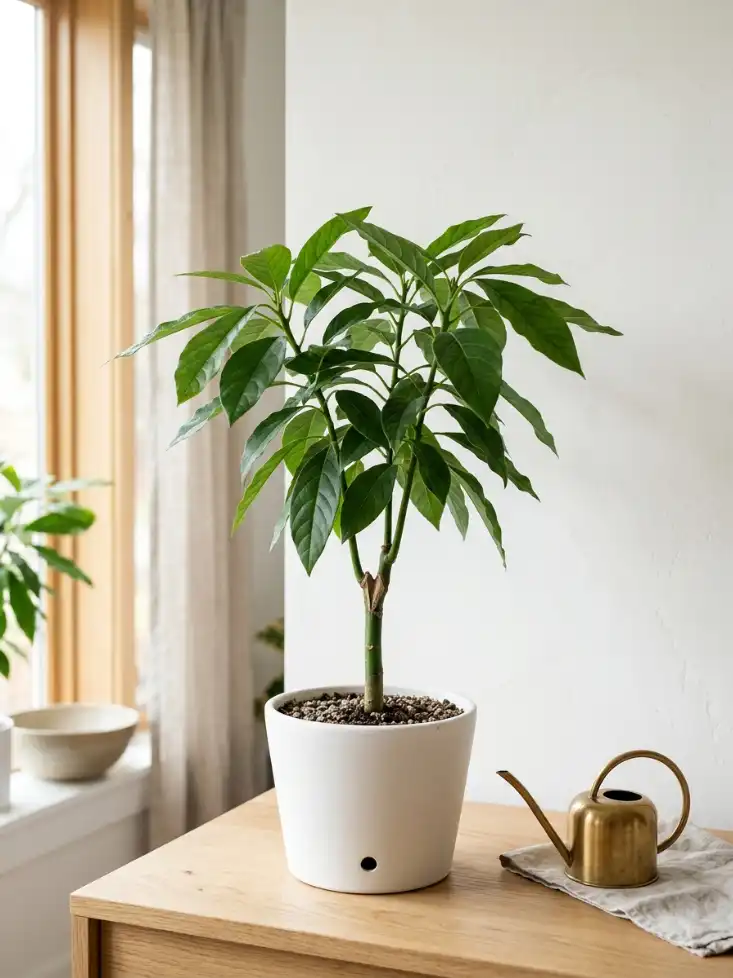
Brogdon Avocado Tree Care Guide
Cold-hardy Type B avocado with distinctive purple-black fruit — an under-the-radar variety that combines Bacon-level frost tolerance (24°F) with rich, nutty flavor. Thin, smooth skin turns deep purple-black when ripe. Ships 20–28 in tall in nursery grow bag.
Shipping restriction: Due to agricultural regulations, we cannot ship this plant to: CA, FL, AZ, HI. Orders to these states will be cancelled and refunded. This protects your local agriculture from pests and diseases. See full shipping policy.
Year-round care calendar
- First fertilizer — use lower-N formula if tree is overly vigorous
- Brogdon pushes strong spring growth — monitor for excessive vigor
- Begin weekly deep watering
- Apply 3-inch mulch — critical for this variety with West Indian heritage
- Increase watering as temperatures rise
- Brogdon flowers — Type B, pair with Hass or Gwen (Type A)
- Second fertilizer
- Deep water 2× per week
- Fruit set — consistent water for summer harvest
- Fruit developing rapidly — Brogdon is a summer-harvest variety
- 10–15 gallons weekly for young trees
- Excellent disease resistance — less spraying needed than Hass
- Harvest window begins — fruit turns from green to deep purple-black
- Test-ripen one fruit: softens in 3–5 days = ready
- Deep water weekly — do not skip during harvest
- Peak harvest — Brogdon fills the summer avocado gap
- Third fertilizer application
- Fruit holds well on tree — harvest as needed over 2–3 months
- Harvest continues — last fruit of the season
- Reduce water as temperatures cool
- Fourth and final fertilizer
- Reduce water — begin winter schedule
- Prepare frost protection — Brogdon is hardy to 24°F but young trees need protection
- Prune for shape — Brogdon is vigorous and needs annual control
- Minimal water
- Install frost protection if needed
- Clean up fallen fruit and leaves to reduce disease carryover
- Protect young trees below 28°F
- Water only during extended dry periods
- Brogdon dormant — no active growth
- Hold all fertilizer
- Inspect for frost damage
- Plan pruning — late February is ideal
- Major pruning window — remove 20–25% of canopy to control vigor
- Remove crossing, rubbing, or downward-growing branches
- Prepare for March fertilizer
Care at a glance
Plant a pair — Brogdon Avocado Tree - Cold-Hardy, Purple Fruit, Type B + Hass Avocado Tree
Compatible pollinator pair. Adding a second variety within 50 feet increases yield by 20–30%. Both plants ship together in one box.
$178.00 $160.00 Save 10%
How to plant your Brogdon Avocado Tree
Harden off — this cold-warrior needs a gentle start
Place in shade for 2–3 days. Keep the grow bag moist. Brogdon is a cold-hardy hybrid (likely Mexican × West Indian) that survives 24°F — tying Bacon for the cold-hardiness crown. But what sets Brogdon apart: purple-black skin that turns dark when ripe, rich buttery flesh, and excellent disease resistance. A sleeper variety that deserves more attention.
2–3 days shade, cold-hardy to 24°F
Dig the right hole — drainage first
Dig twice as wide and exactly as deep as the container. Well-draining soil is essential — in clay, plant on a raised mound. Brogdon has good natural disease resistance (especially to scab), but no avocado tolerates wet feet.
Excellent drainage, wide hole
Plant shallow, mulch, water deep
Graft union 3–4 inches above soil. Backfill with native soil. Apply 3 inches coarse mulch in a 3-foot ring, 6 inches from trunk. Water 5 gallons. Brogdon is Type B — pair with Hass or Gwen (Type A) for cross-pollination. The fruit has purple-black skin (turns dark when ripe) with rich, buttery yellow flesh — described as “Hass-quality flavor in a cold-hardy package.”
5 gallons, Type B, purple-black fruit
Brogdon Avocado Tree Care Guide — ongoing care
Spring (March–May)
Water: Ramp up weekly deep soaks — 10–15 gallons for young trees. Brogdon is more drought-tolerant than other avocados once established.
Fertilize: March first feeding with citrus/avocado formula. Young: 1/4 cup. Mature: 1–2 cups.
This season: Brogdon is Type B — excellent pollinator for Type A varieties. It is one of the most cold-hardy avocados available, surviving 22°F once mature. New spring growth has a distinctive reddish-purple tint. Second fertilizer in May.
Summer (June–August)
Water: Deep, infrequent watering. Unlike Hass, Brogdon tolerates slightly drier soil. Deep soak 1–2× per week, let top 3 inches dry between.
Fertilize: August application. Watch for iron chlorosis.
This season: Brogdon harvest begins in July — much earlier than other avocados. Fruit is pear-shaped, 8–16 oz, with smooth dark-purple skin. The thin skin makes it less shippable commercially but perfect for home growing. Flavor is rich and nutty, often preferred over Hass in taste tests.
Fall (September–November)
Water: Reduce as temperatures drop. Brogdon can handle drier fall soil than other varieties.
Fertilize: Final feeding in October. Stop November–January.
This season: Harvest winds down through September. By October, the tree shifts energy from fruit to root development. Allow fallen leaves to remain as natural mulch. In Zone 8, this is the time to prepare winter protection.
Winter (December–February)
Water: Minimal — only during extended dry spells. Brogdon’s drought tolerance shines in winter.
Fertilize: None. Resume February.
This season: Brogdon is the cold-hardiest avocado we carry — mature trees survive 22°F. Young trees: protect below 26°F. In Zone 8b, it can grow in-ground with a south-facing wall and frost cloth during hard freezes. February–March bloom restarts the cycle.
Pruning: manage the vigor
When: Late winter (February–March), before spring growth. Never prune in fall.
Vigor alert: Brogdon is a vigorous grower — it will outgrow Hass and Fuerte if left alone. Annual pruning is not optional, it is required to keep the tree manageable. Select 3–4 scaffold branches early and maintain an open vase shape.
Annual routine: Thin interior growth for light and airflow. Remove crossing, rubbing, or downward-growing branches. Heading cuts (cutting back by 1/3) stimulate branching and control height. Brogdon responds well to pruning — it pushes vigorous new growth from cuts.
Height control: Aggressively top at 12–15 feet. An unpruned Brogdon will reach 30+ feet within a decade. Prune every year, not every 3 years — it is easier to maintain than to reclaim.
DON’T: Remove more than 25% of canopy in one season. Leave stubs. Paint wounds. Skip a year — this variety does not forgive neglect.
What’s wrong with my Brogdon?
Still stuck? Send a photo to artisticbonsai.sz@gmail.com — we diagnose it for free. Response within 24 hours.
Harvesting Brogdon Avocados
When: July through September — a summer harvest window that complements fall/winter varieties. Brogdon fruit turns from green to deep purple-black when mature. Fruit is pear-shaped, 8–16 oz, with rich buttery yellow flesh described as “Hass-quality in a cold-hardy tree.”
Test method: Pick one dark fruit, ripens on the counter in 3–5 days. If it softens evenly, the crop is ready. Brogdon fruit holds well on the tree — harvest as needed over 2–3 months.
Ripening: Room temperature, 3–5 days. Paper bag + banana speeds it up. Ripe when neck yields to gentle pressure. Once ripe, refrigerate up to 3 days.
Strategic value: Brogdon + Hass = avocados from July through March (9 months of the year). Brogdon covers summer, Hass covers fall/winter. Add a spring variety (Gwen) and you have year-round avocados from three trees.
Frequently asked questions
How cold-hardy is Brogdon compared to other avocados?
Brogdon (24°F) ties with Bacon for the most cold-hardy commercial avocado. For reference: Fuerte (26°F), Hass (28–30°F), Gwen (28–30°F). The Mexican parentage provides cold tolerance; the West Indian parentage adds humidity tolerance and disease resistance. This is the variety for Zone 8 growers and anyone pushing the northern edge of avocado range.
What does Brogdon taste like?
Rich, buttery, and nutty — comparable to Hass in quality. The flesh is a deep golden-yellow with high oil content, giving it that luxurious mouthfeel. Some tasters detect a subtle sweetness that Hass lacks. The skin is thin and purple-black when ripe — peels away easily. If you like Hass, you will like Brogdon.
Brogdon vs Bacon — which cold-hardy variety is better?
Both survive 24°F. Key differences: Fruit: Brogdon has purple-black skin (like Hass) and rich, buttery flesh; Bacon stays green with milder, lighter flesh. Harvest: Brogdon is summer (July–Sept); Bacon is fall/winter (Nov–March). Growth: Brogdon is more vigorous; Bacon is more moderate. Best strategy: Plant both — they are compatible pollinators (Brogdon Type B, Bacon Type B… wait, both are Type B, so they won’t cross-pollinate each other. Pair Brogdon with a Type A like Hass for pollination, and enjoy summer + winter harvests.
Is Brogdon disease-resistant?
Yes — Brogdon has excellent resistance to avocado scab and good tolerance to anthracnose, thanks to its West Indian parentage. In humid climates (Florida, Gulf Coast, Southeast), this is a significant advantage — less spraying, fewer blemished fruit. It is not immune to Phytophthora root rot (nothing is), but its overall disease package is better than most commercial varieties.
Does Brogdon need a pollinator?
Brogdon is Type B and partially self-fruitful. A Type A pollinator (Hass, Gwen) within 50 feet increases yield by 20–30%. For a cold-hardy pairing, Hass (Type A, 28–30°F) works if your climate allows. For maximum cold hardiness, you need both a cold-hardy Type A and Type B — but most cold-hardy varieties (Bacon, Brogdon) are Type B.
How big does Brogdon get?
Vigorous — 25–35 feet unpruned. Regular pruning easily maintains 12–15 feet. The tree has a spreading, open growth habit. Container trees stay at 6–8 feet in a 25-gallon pot. Brogdon grows faster than Hass — annual pruning is essential from year 3 onward.